

Why Boredom Is Actually a Signal From Your Brain, Not Laziness
You sit down to work and immediately feel restless. The task ahead isn't hard - it's just... boring. Within minutes, you're checking your phone, opening new tabs, searching for anything that feels more engaging. Then comes the guilt: "Why am I so lazy?"
But here's the problem with that question. Boredom isn't laziness. It's not a character flaw or a sign that you lack discipline. Boredom is your brain's way of telling you something specific - and most people have never learned to listen.
This post unpacks why boredom is actually a signal from your brain, not laziness, what that signal means, and what you can actually do about it.

The Difference Between Boredom and Laziness
Laziness and boredom get conflated constantly, but they're fundamentally different experiences with different causes.
Laziness (if we're being precise about it) suggests an unwillingness to expend effort even when something matters to you. It's avoidance driven by low motivation or apathy.
Boredom, on the other hand, is a state of under-stimulation. Your brain is awake, alert, and ready to engage - but the current activity isn't providing enough novelty, challenge, or meaning to hold your attention. You're not avoiding effort. You're seeking stimulation that isn't there.
That distinction matters. When you misdiagnose boredom as laziness, you blame yourself for something that's actually a mismatch between your brain's needs and your environment.
What Boredom Actually Signals
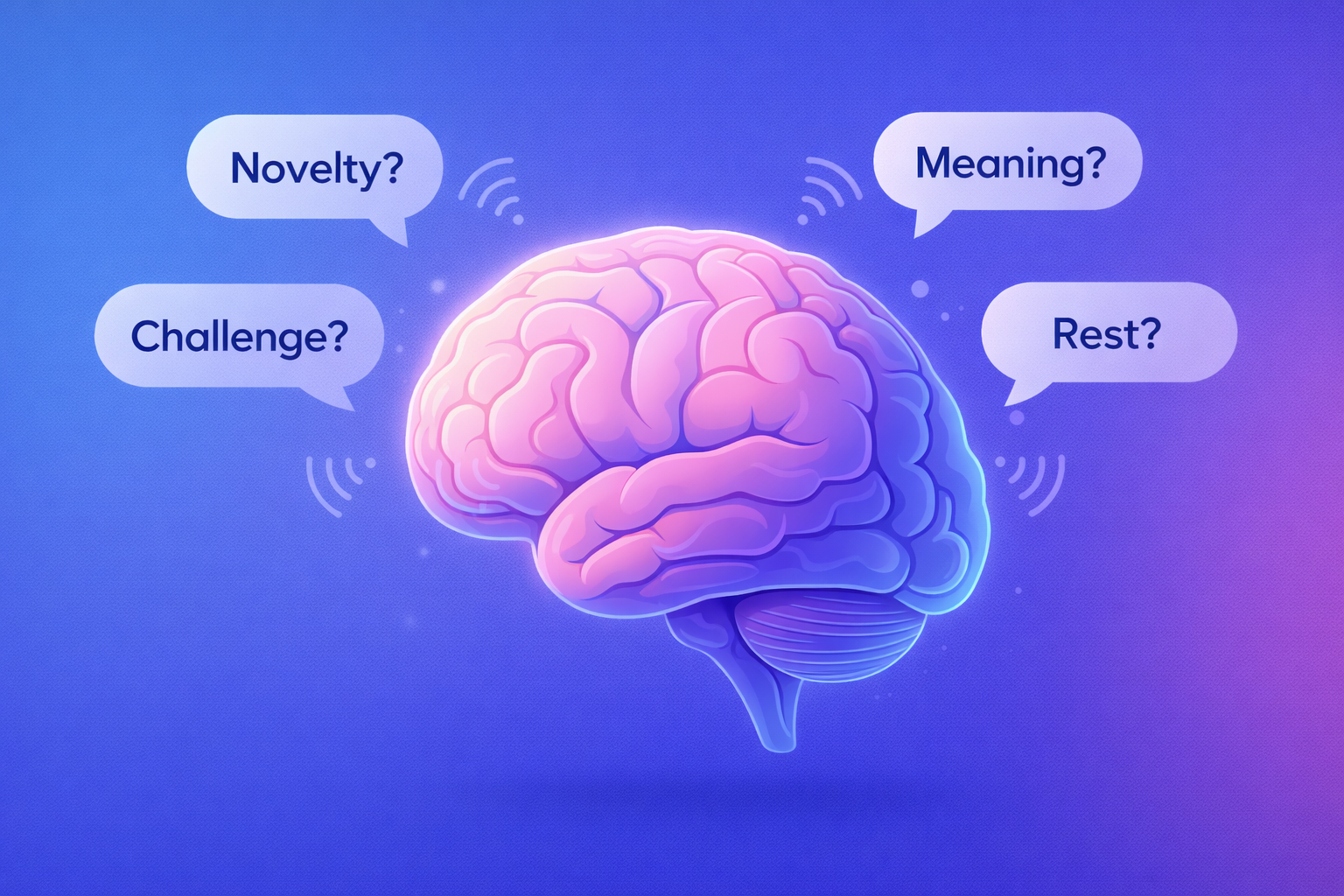
Neuroscience research suggests boredom is an emotional and cognitive state tied to a few specific patterns. When you feel bored, your brain is usually communicating one or more of these messages:
1. Your Task Lacks Novelty or Challenge
The brain is wired to seek new information. Repetitive tasks that offer no learning, no variation, and no challenge trigger what researchers call a 'novelty deficit.' Your attention systems disengage because there's nothing to process that feels worth processing.
This is why you can spend three hours absorbed in a puzzle or a new skill but can't focus for 20 minutes on a spreadsheet you've filled out a hundred times. It's not willpower. It's the mismatch between the task and your brain's need for cognitive engagement.
2. The Activity Has No Clear Meaning or Purpose
Humans tolerate boredom much better when the task connects to something that matters. Research on intrinsic motivation shows that even tedious activities become bearable when they align with personal values or long-term goals.
When meaning is absent, boredom intensifies. This is one reason why understanding your deeper motivations can shift how you experience even mundane work. A task doesn't become interesting just because you attach meaning to it - but meaning provides the context that helps your brain stay engaged long enough to finish.
3. You're Mentally Fatigued or Cognitively Depleted
Boredom can also surface when your brain is too tired to engage properly. Mental fatigue reduces your capacity for sustained attention, making even moderately interesting tasks feel unbearable. This often gets confused with laziness, but it's actually cognitive depletion.
If you notice boredom appearing consistently late in the day or after periods of intense focus, it's worth considering whether what you're experiencing is less about the task and more about chronic stress or mental exhaustion.
4. Your Environment Lacks Stimulation
Some people have a higher baseline need for stimulation than others. If you're someone with a naturally high need for novelty (sometimes linked to personality traits like sensation-seeking or openness to experience), you'll experience boredom more frequently in low-stimulation environments - not because you're lazy, but because your brain literally requires more input to stay engaged.
Why We Misinterpret Boredom as a Personal Failing
Culture plays a huge role in how we interpret boredom. Many of us were raised to see busyness as virtue and boredom as something to be ashamed of. If you're bored, you must not be trying hard enough. You must lack drive. You must be lazy.
But that narrative ignores what boredom actually is: an information-processing problem, not a moral one. Your brain is telling you it's under-engaged. That's useful data - not a character assessment.
The guilt around boredom also ties into the broader misconception that motivation should come first, followed by action. In reality, the opposite is often true. Research on behaviour activation suggests that action frequently precedes motivation - which means waiting until you 'feel like it' often keeps you stuck in boredom indefinitely.
What to Do When You're Bored
Understanding boredom as a signal changes how you respond to it. Here are a few research-informed strategies:
Ask What Your Brain Actually Needs
Instead of forcing yourself through boredom or distracting yourself endlessly, pause and ask: What is this boredom telling me?
• Am I under-stimulated because the task is too easy or repetitive?
• Is the work disconnected from anything I care about?
• Am I mentally exhausted and need rest, not more stimulation?
• Is my environment chronically low in novelty or challenge?
The answer determines the response. If you're depleted, forcing productivity will backfire. If you're under-challenged, the solution is complexity, not distraction.
Inject Novelty Without Abandoning the Task
If the task itself is non-negotiable but boring, you can sometimes add novelty around the edges:
• Change your physical environment (work from a different room or location)
• Time-box the task into short, focused intervals with clear breaks
• Pair the boring task with something mildly stimulating (music, a podcast, background noise)
• Gamify progress with visible markers (checklists, timers, small rewards)
These won't make the task inherently interesting, but they reduce the cognitive drag boredom creates.
Reconnect the Work to Something That Matters
When possible, clarify the purpose. Why does this task exist? What does completing it enable? This doesn't manufacture false motivation, but it does provide the scaffolding your brain needs to sustain attention. The connection between identity and behaviour is explored further in why identity-based habits last longer than goal-based ones - the same principle applies here.
Recognize When Boredom Signals a Deeper Misalignment
Sometimes boredom isn't situational. It's chronic. If you feel bored most of the time across multiple contexts - work, hobbies, relationships - that may signal something beyond task design. Chronic boredom has been linked to depression, lack of purpose, and deeper existential dissatisfaction.
In those cases, surface-level productivity hacks won't help. What helps is addressing the underlying pattern. This might involve exploring why you feel emotionally numb or disconnected, examining whether your current path aligns with your values, or working with a therapist to untangle what's underneath the boredom.

Boredom Isn't the Enemy
One final point worth making: boredom, in moderation, isn't inherently bad. Some research suggests that brief periods of boredom can actually facilitate creativity, self-reflection, and problem-solving. When your brain isn't occupied with external input, it defaults to internal processing - daydreaming, memory consolidation, pattern recognition.
The issue isn't boredom itself. It's chronic, unaddressed boredom - the kind that comes from sustained under-stimulation, lack of meaning, or being stuck in situations that don't align with who you are or what you need.
Listen to What Your Brain Is Telling You
Boredom is a signal, not a flaw. It tells you when something isn't engaging your brain the way it needs to be engaged. That could mean the task is too easy, the purpose is unclear, you're mentally exhausted, or your environment lacks the stimulation you require.
The next time you catch yourself scrolling aimlessly or struggling to focus, try this: instead of labeling it laziness, ask what the boredom is signaling. That simple shift - from self-criticism to curiosity - changes everything.
You're not broken. Your brain is just trying to communicate. And once you learn its language, you can respond in ways that actually help.


