

Nudge Theory in Everyday Life: How Small Changes Shape Big Decisions
You walk into a cafeteria. The salad sits at eye level near the register. The cookies hide in the back corner, requiring extra steps to reach. You choose the salad, feeling virtuous about your "decision." But was it really your choice, or were you nudged?
Every day, you make hundreds of decisions influenced by invisible architecture—the way options are presented, defaults are set, and choices are framed. This isn't manipulation in the sinister sense. It's nudge theory, a concept from behavioral economics that recognizes a simple truth: how choices are presented matters as much as what the choices are. Richard Thaler won a Nobel Prize for formalizing this idea. Understanding nudges helps you recognize when you're being influenced and gives you tools to design better choices for yourself and others.
What Nudge Theory Actually Means
The Origins: Thaler and Sunstein
Behavioral economist Richard Thaler and legal scholar Cass Sunstein introduced nudge theory in their 2008 book "Nudge: Improving Decisions About Health, Wealth, and Happiness."
Their core insight: people aren't perfectly rational. We use mental shortcuts, get overwhelmed by too many options, stick with defaults out of laziness, and make different decisions based on how information is framed—even when the underlying facts are identical.
A nudge is an intervention that steers people toward better decisions without restricting their freedom to choose. You can still pick the cookies. The cafeteria just made the salad easier to grab.
Key characteristics of a nudge:
- Preserves freedom of choice (not a mandate or ban)
- Works with human psychology, not against it
- Requires minimal thought or effort
- Guides toward beneficial outcomes
- Easy and cheap to avoid if you want to
Choice Architecture Explained
Every choice exists within an architecture—the context and structure in which decisions get made. Someone always designs this architecture, whether intentionally or accidentally.
Choice architects can be:
- Governments designing tax forms
- Companies arranging products on shelves
- Doctors explaining treatment options
- Parents setting up their kitchen
- You, organizing your own environment
The question isn't whether choice architecture exists. It always does. The question is whether it's designed thoughtfully or left to chance.
Thaler argues there's no such thing as a "neutral" presentation of choices. Even randomizing options is a choice that affects decisions differently than alphabetical ordering.
 10 Nudges You Encounter Every Day (And Don't Notice)
1. Default Settings That Do the Thinking
The nudge: Whatever comes pre-selected tends to stay selected. Most people accept defaults without changing them.
Real-world examples:
Organ donation rates in Austria: 99%. In Germany: 12%. The medical systems are similar. The difference? Austria uses opt-out (you're automatically a donor unless you decline). Germany uses opt-in (you must actively register).
Your phone's privacy settings come with defaults. App permissions default to "allow" or "deny." Most users never change them. Tech companies know this and set defaults that benefit their business model.
Retirement savings plans with automatic enrollment see 90%+ participation. Plans requiring active enrollment see 30-40% participation. Same benefits, different default.
How it works: Changing defaults requires effort and decision-making. When you're busy or uncertain, accepting the default is the path of least resistance. Your brain interprets defaults as implicit recommendations—"this must be the normal or correct choice."
2. Placement Strategies in Supermarkets
The nudge: Eye-level items sell better than items requiring bending or reaching. Products at checkout get more impulse purchases.
Real-world examples:
Children's cereals sit on lower shelves where kids can see them. Healthy options go at adult eye level. Neither location prevents you from buying what you want, but placement influences what catches your attention.
Milk and eggs are almost always in the back of the store. You walk past hundreds of products to reach them, increasing the likelihood you'll grab something else.
Checkout aisles used to display only candy. Many stores now include healthier snacks at checkouts—a conscious choice architecture shift responding to public health concerns.
How it works: Visual attention is finite. You notice what's directly in your line of sight. Items requiring extra physical or mental effort (looking down, reaching back, searching) get chosen less often.
3. Social Proof Notifications
The nudge: Telling people what others are doing influences their behavior more than telling them what they should do.
Real-world examples:
Hotel cards saying "75% of guests reuse their towels" increase reuse rates more than environmental appeals. We look to others to determine normal behavior.
Energy bills showing how your usage compares to neighbors reduce consumption by 2-3%. The word "neighbors" matters—comparisons to distant strangers have less impact.
Restaurant menus marking items as "most popular" or "chef's favorite" boost sales of those dishes by 15-20%.
How it works: Humans are social animals. When uncertain, we copy what others do. This heuristic usually serves us well but makes us susceptible to manufactured social proof.
4. Opt-Out vs. Opt-In Design
The nudge: Requiring people to take action to refuse something gets higher participation than requiring action to accept it.
Real-world examples:
Email subscriptions often come pre-checked when you make a purchase. You must actively uncheck the box to avoid them.
401(k) plans with automatic enrollment (you're in unless you opt out) achieve 90% participation. Traditional opt-in plans get about 40%.
Free trial periods that automatically convert to paid subscriptions unless you cancel exploit this principle—many people forget to cancel even when they planned to.
How it works: Inertia is powerful. Taking action requires motivation and effort. Opt-out design makes inaction the path that gets you enrolled. Ethically questionable when used manipulatively, but powerful when used to help people achieve stated goals they struggle to follow through on.
5. Visual Cues That Guide Behavior
The nudge: Images, arrows, and markers direct attention and action without words.
Real-world examples:
Footprints on the floor leading to trash cans reduce littering. Airport floor arrows guide passenger flow during COVID reduced crowding by 30%.
Flies painted in urinals at Amsterdam's airport reduced spillage by 80%. Men unconsciously aimed at the target.
Red plates at buffets lead people to take 30% less food. The color triggers a subtle stop signal.
How it works: Visual processing happens faster than verbal processing. Your brain responds to images and colors before conscious thought kicks in. Well-designed visual nudges tap into automatic responses.
6. Friction and Convenience
The nudge: Adding small obstacles to unwanted behaviors or removing obstacles from desired behaviors shifts what people do.
Real-world examples:
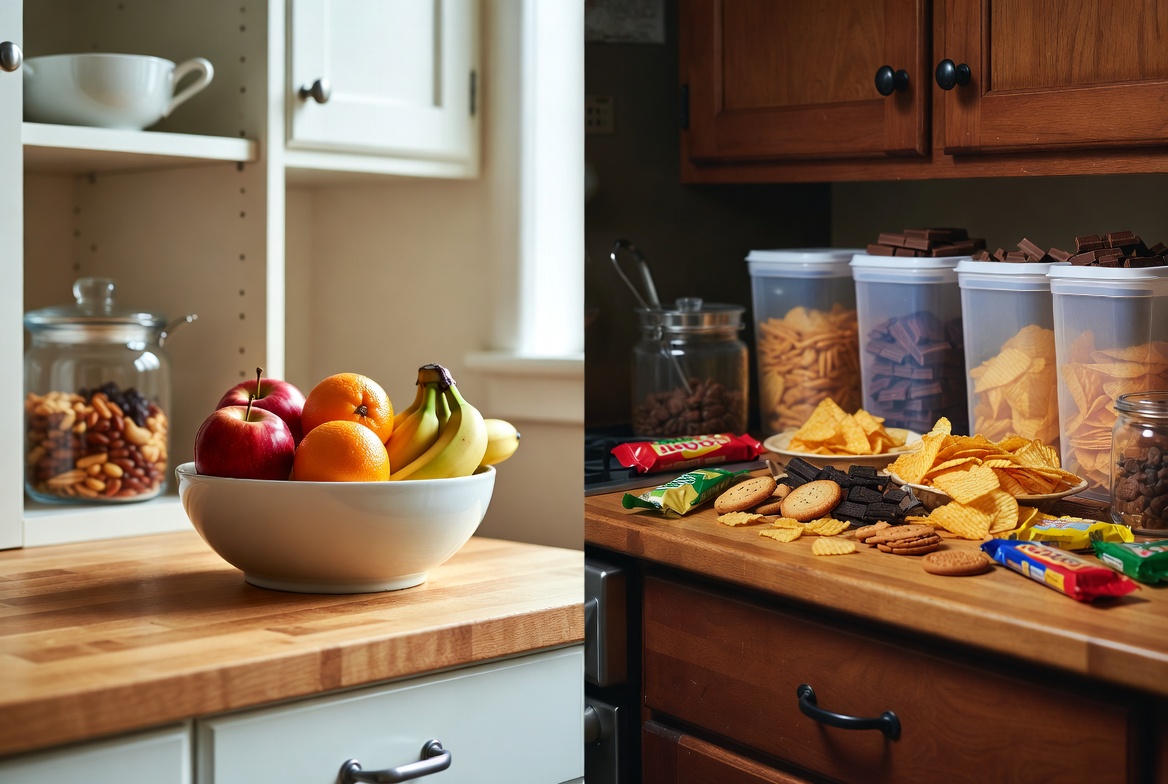
Putting junk food in opaque containers reduces consumption by 40% compared to clear containers. Adding one extra step (opening the container) creates enough friction to change behavior.
Pre-sliced fruits increase consumption. Same nutritional value, but reduced preparation effort makes healthy eating more likely.
Netflix autoplay removes friction from watching another episode. You must actively decide to stop rather than actively decide to continue.
How it works: Your brain constantly calculates effort. Small increases in friction deter behavior. Small decreases enable it. The effort difference can be trivial (reaching into a drawer vs. grabbing from the counter) yet impact behavior significantly.
7. Loss Framing
The nudge: Presenting information as a potential loss rather than an equivalent gain motivates action more effectively.
Real-world examples:
"You're losing $200 per year by not switching energy providers" works better than "You could save $200 by switching." Psychologically, losses hurt more than equivalent gains feel good.
Credit card surcharges framed as "cash discounts" face less resistance than "card fees," even when the price difference is identical.
Health messages saying "1 in 10 people who don't get screened will develop this disease" motivate screening more than "9 in 10 people who get screened will stay healthy."
How it works: Loss aversion is one of the most robust findings in behavioral economics. Your brain weights potential losses about twice as heavily as equivalent gains. Marketers and policymakers leverage this asymmetry.
8. Commitment Devices
The nudge: Getting people to commit to a future action increases follow-through, especially when the commitment is public or involves stakes.
Real-world examples:
Stickk.com lets you put money on the line for goals. If you fail, your money goes to a charity you hate. The threat of loss to a disagreeable cause increases success rates.
Appointment confirmation texts reduce no-shows by 20-30%. Replying "yes" creates a small commitment that makes canceling feel inconsistent.
Gym memberships that charge weekly instead of monthly see 17% higher attendance. More frequent reminders of the financial commitment nudge you to use what you're paying for.
How it works: Humans have a strong desire for consistency. Once you've committed, backing out creates cognitive dissonance. Public commitments add social accountability, increasing the psychological cost of failing to follow through.
9. Simplification and Choice Reduction
The nudge: Reducing the number of options increases decision-making and satisfaction.
Real-world examples:
Sweden's pension system offered 456 fund options. Most people felt overwhelmed and chose randomly or avoided choosing. They redesigned it with a simple default and 7 highlighted options. Decision quality and satisfaction improved.
Restaurants with 20-item menus see faster ordering and higher satisfaction than those with 100+ items. Fewer options reduce decision fatigue.
Medicare Part D initially offered seniors 50+ prescription drug plans. Studies showed that simplifying to 3-5 options increased enrollment and reduced errors.
How it works: Too many choices paralyze decision-making (analysis paralysis) and increase regret (you wonder if a different choice was better). Curating options to a manageable number makes choosing easier and more satisfying.
10. Salience and Timing
The nudge: Making information prominent at the moment of decision changes behavior more than providing the same information earlier or later.
Real-world examples:
Calorie counts on menus reduce calorie consumption by 8-10% when placed next to items, but have minimal impact when in a separate nutrition guide.
Text messages sent the night before appointments reduce no-shows more than reminders sent a week earlier. Timing the nudge close to the action window matters.
Red warning labels on high-sugar foods at the point of selection reduce purchases by 15%. The same information on package backs (requiring you to pick up and flip the item) has almost no effect.
How it works: Attention is time-sensitive. Information given too early gets forgotten. Information given too late arrives after the decision. Effective nudges present crucial information at the exact moment it's relevant.
How to Apply Nudge Theory in Your Own Life
Nudging Yourself Toward Better Habits
You're both the choice architect and the decision-maker for your own life. Use that to your advantage.
Want to eat healthier?
- Put fruit in a visible bowl on the counter
- Store junk food in opaque containers in inconvenient locations
- Use smaller plates (visual cue that tricks satiety signals)
- Pre-cut vegetables so healthy snacking requires zero effort
Want to exercise more?
- Sleep in your workout clothes (removes morning friction)
- Put your gym bag by the door (visual reminder)
- Schedule workouts as calendar appointments (commitment device)
- Join a class where missing is noticeable (social accountability)
Want to save money?
- Set up automatic transfers to savings the day after payday (default + salience)
- Use cash for discretionary spending (friction makes you think before purchasing)
- Track spending visually on a chart in your wallet (immediate feedback)
Want to read more?
- Keep a book on your pillow (you literally can't get into bed without moving it)
- Delete social media apps from your phone home screen (add friction to mindless scrolling)
- Set your phone to black-and-white mode after 8 PM (reduces digital appeal)
Using Nudges as a Parent
Parents are choice architects for their children. Thoughtful nudges teach decision-making while guiding toward beneficial choices.
Nutrition:
- Let kids serve themselves from platters at the table, but put vegetables out first when they're hungriest
- Cut fruit and leave it visible; keep treats in high cabinets
- Use kid-sized plates with dividers that make the vegetable section prominent
Homework and responsibilities:
- Create a designated homework spot with supplies ready (remove friction)
- Use visual checklists with checkboxes (satisfying to complete, concrete progress)
- Frame chores as contributions rather than requirements ("we need your help" vs. "you have to")
Screen time:
- Set devices to automatically turn off at bedtime (default)
- Create "phone parking" spots where devices charge overnight outside bedrooms
- Offer compelling alternatives visibly (board games on the shelf, art supplies on the table)
Money management:
- Give allowance in three jars: spend, save, give (physical separation makes abstract concepts concrete)
- Let them make small purchasing mistakes to learn from loss aversion naturally
Workplace Applications
Managers and team leaders can use nudges to improve performance and wellbeing without top-down mandates.
Meetings:
- Default to 25 or 50-minute meetings instead of 30 or 60 (builds in transition time)
- Stand-up meetings in rooms without chairs (natural time limit through physical discomfort)
- Agenda sent 24 hours in advance with "no agenda = no meeting" policy (social norm)
Productivity:
- Set "focus time" blocks on team calendars where meetings are discouraged (opt-out design)
- Put healthy snacks at eye level in break rooms
- Create collaboration spaces that are inviting and work spaces that minimize distraction
Communication:
- Frame feedback as "here's what worked well" before "here's what to improve" (positivity before criticism reduces defensiveness)
- Use subject lines that indicate required action level: [INFO], [INPUT NEEDED], [ACTION REQUIRED] (salience)
Remote work:
- Encourage "camera optional" as default to reduce Zoom fatigue (removes social pressure)
- Share "end-of-day routines" that signal work closure (creates norms around boundaries)
The Ethics Question: When Nudges Cross the Line
Nudge theory raises legitimate ethical concerns. When does helpful guidance become manipulation?
Ethical nudges:
- Transparent in intent
- Align with the person's stated goals
- Easy to opt out of
- Don't exploit vulnerabilities
- Improve welfare from the recipient's perspective
Problematic nudges:
- Hidden or deceptive
- Serve only the nudger's interests
- Difficult to avoid or reverse
- Exploit cognitive limitations for profit
- Harm wellbeing while appearing beneficial
Examples of ethical gray areas:
Grocery stores putting candy at checkouts nudges impulse purchases. Is this unethical manipulation or just smart merchandising? It depends partly on whether the store also offers healthy impulse options and whether the nudge exploits children's poor self-control.
Auto-renewing subscriptions nudge continued payment through inertia. Is this a reasonable business model or exploitative? It depends on transparency, ease of cancellation, and whether customers actually want the service.
Thaler's transparency test: Would you be comfortable if the nudge were made public? If hiding the mechanism is necessary for it to work, that's a warning sign.
The "reflective endorsement" test: Would people endorse the nudge if they understood how it works? Organ donation defaults likely pass this test—most people want to donate but forget to register. Hidden fees in contracts likely fail—understanding them would make people angry.
Creating Your Own Nudge System
Step 1: Identify the behavior you want to change
Be specific. Not "be healthier" but "eat vegetables with dinner 5 days per week."
Step 2: Analyze current choice architecture
What's the default right now? What's easy versus hard? What catches your attention? Where's the friction?
Step 3: Choose your nudge type
Match the nudge to the barrier:
- If the problem is forgetting → use defaults or visual cues
- If the problem is effort → reduce friction
- If the problem is motivation → use commitment devices or social proof
- If the problem is too many options → simplify
Step 4: Test and adjust
Nudges work through psychology, which varies by person. Try your nudge for two weeks. If behavior doesn't shift, try a different approach.
Step 5: Stack nudges for compound effects
Combine multiple nudge types. Want to meditate daily? Set app as phone wallpaper (visual cue), meditate right after morning coffee (habit stacking), track streaks visibly (commitment device), join a group (social proof).
Nudge theory isn't about controlling people. It's about recognizing that every choice exists in a context, and context shapes decisions. You're already being nudged hundreds of times daily—by store layouts, website designs, default settings, and social norms. Understanding these mechanisms helps you make more conscious choices when it matters and design better choices for yourself and others when you're the architect. The question isn't whether to use nudges. It's whether to use them thoughtfully or let them happen by accident.


