

How Self-Compassion Differs From Self-Esteem and Why It Matters More
You make a mistake at work. A significant one. Your first thought: I am such an idiot. Your second thought: I should be kinder to myself. Your third thought: Does that mean I am supposed to pretend this was not my fault?
This is where most people get stuck. The concept of self-compassion sounds good in theory but feels confusing in practice. It gets tangled up with self-esteem, self-indulgence, or self-deception. And the real question - how self-compassion differs from self-esteem - rarely gets answered clearly enough to use.
This post breaks down the distinction, explains why it matters psychologically, and shows you what self-compassion actually looks like when you practice it.
What Self-Esteem Actually Is
Self-esteem is an evaluation. It is the judgment you make about your own worth, typically based on how you compare to others or how well you meet your own standards. High self-esteem means you evaluate yourself positively. Low self-esteem means the opposite.
The self-esteem movement of the 1980s and 90s was built on a reasonable premise: people who feel good about themselves tend to do better in life. Schools began teaching children to repeat affirmations. Parents were told to praise constantly. The cultural message became: Believe in yourself, and everything else will follow.
But decades of research have revealed a problem. Self-esteem is fragile. It depends on external validation, social comparison, and success. When things go well, self-esteem rises. When things go badly, it collapses. And when self-esteem is threatened, people often become defensive, aggressive, or self-critical - the exact opposite of what high self-esteem is supposed to produce.
What Self-Compassion Actually Is
Self-compassion, a concept developed by psychologist Kristin Neff, is not an evaluation. It is a way of relating to yourself - particularly in moments of failure, pain, or inadequacy.
Neff identifies three core components:
• Self-kindness: Treating yourself with warmth and understanding rather than harsh judgment.
• Common humanity: Recognizing that struggle, failure, and imperfection are part of the shared human experience, not evidence of personal deficiency.
• Mindfulness: Holding your painful thoughts and emotions in balanced awareness rather than over-identifying with them or suppressing them.
Notice what is absent from that definition: comparison, achievement, or proving your worth. Self-compassion does not ask Am I good enough? It asks How can I support myself right now?

The Core Difference: Evaluation vs. Acceptance
The fundamental distinction is this:
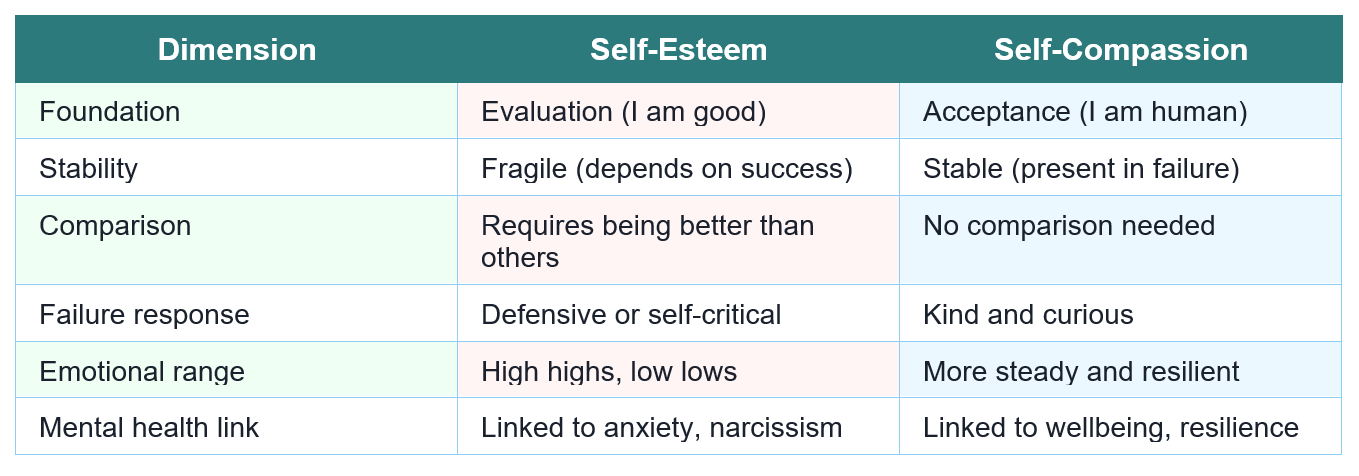
Self-esteem is contingent. It rises and falls based on how you are doing. If you succeed, you feel good about yourself. If you fail, you do not. Your worth is tied to performance, appearance, social approval, or other external markers.
Self-compassion is unconditional. It does not depend on whether you are winning or losing. It is the recognition that you deserve kindness simply because you are a human being experiencing difficulty - not because you earned it by being good enough.
This difference shows up most clearly in how you respond to failure. Self-esteem says: I failed, so I must be worthless. Self-compassion says: I failed, and that hurts. What do I need right now?
Self-Esteem vs. Self-Compassion: A Side-by-Side Comparison
The table below highlights the key psychological differences:
Why Self-Esteem Can Be Psychologically Risky
High self-esteem is not inherently bad. But research suggests it comes with hidden costs that self-compassion does not.
1. Self-Esteem Requires Social Comparison
To feel good about yourself, you often need to believe you are better than someone else - smarter, more attractive, more successful. This creates a zero-sum game where someone else's success threatens your own sense of worth.
Self-compassion eliminates the need for comparison. You are not competing with anyone. You are simply being kind to yourself.
2. Self-Esteem Is Fragile Under Threat
When self-esteem is challenged - through criticism, failure, or rejection - people with high but fragile self-esteem often react defensively. They blame others, deny responsibility, or lash out. This is the ego protecting itself.
Self-compassion, by contrast, allows you to acknowledge failure without it threatening your core sense of worth. This is why self-compassion is linked to greater emotional resilience in relationships.
3. Self-Esteem Can Enable Narcissism
Not all high self-esteem is healthy. Research distinguishes between secure high self-esteem (grounded in real competence and connection) and fragile high self-esteem (defensive and inflated). The latter is closely linked to narcissistic traits.
Self-compassion, by definition, cannot become narcissistic. It includes awareness of common humanity - the recognition that you are not special in your suffering, just human.
Why Self-Compassion Matters More
Decades of research now suggest that self-compassion is a better predictor of psychological wellbeing than self-esteem. Here is why.
It Is Stable Across Success and Failure
Self-esteem fluctuates with circumstances. Self-compassion remains steady. Whether you are having the best day of your life or the worst, self-compassion says: You still deserve kindness.
This stability is why self-compassion is protective against depression and anxiety. When you do not need external validation to treat yourself well, you are less vulnerable to life's inevitable ups and downs. This connects to why people choose comfort over growth - self-esteem often keeps you in your comfort zone to avoid the risk of failure, while self-compassion allows you to take risks because failure does not destroy your worth.
It Reduces Self-Criticism Without Lowering Standards
One common misconception is that self-compassion means lowering your standards or letting yourself off the hook. Research shows the opposite. People high in self-compassion are more likely to take responsibility for their mistakes, apologize when appropriate, and work to improve - precisely because they are not consumed by shame and defensiveness.
Self-esteem says: I need to be perfect to be worthy. Self-compassion says: I am worthy even when I am not perfect, and I can still work on getting better.
It Supports Genuine Connection
Self-esteem, when contingent on being better than others, creates distance. Self-compassion, grounded in common humanity, creates connection. When you recognize that everyone struggles, you stop isolating in your pain. This is explored further in how emotional understanding builds deeper connections.
What Self-Compassion Looks Like in Practice
Self-compassion is not a feeling you generate. It is a practice. Here is what it looks like in real situations.
After a Mistake
Self-esteem response: I cannot believe I did that. I am so stupid. Everyone must think I am incompetent.
Self-compassion response: That was a real mistake, and I feel embarrassed. Making mistakes is part of being human. What can I learn from this, and what do I need to move forward?
During Criticism
Self-esteem response: They are wrong. I did everything right. They just do not understand.
Self-compassion response: That feedback stings. Is there truth in it? Even if it was delivered harshly, what can I take from this? And how can I be kind to myself while I process it?
When Comparing Yourself to Others
Self-esteem response: They are doing so much better than me. I must be failing.
Self-compassion response: Seeing someone else succeed brings up insecurity for me. That is normal. My path is different from theirs, and I am doing my best with what I have.
How to Build Self-Compassion
Self-compassion is a skill. Like any skill, it improves with deliberate practice.
1. Notice Your Self-Talk
Pay attention to the voice in your head when things go wrong. Would you speak to a friend that way? If not, why is it acceptable to speak to yourself that way?
2. Use the Self-Compassion Break
When you notice you are struggling, pause and say three things:
• This is a moment of suffering. (Mindfulness)
• Suffering is part of life. Everyone experiences this. (Common humanity)
• May I be kind to myself in this moment. (Self-kindness)
3. Write Yourself a Compassionate Letter
Think of a situation where you feel shame or inadequacy. Write yourself a letter from the perspective of a deeply compassionate friend. What would they say to you? How would they frame your struggle?
4. Treat Failure as Data, Not Identity
When something goes wrong, resist the urge to make it mean something about your worth. Ask instead: What happened? What can I learn? What support do I need?
The Shift That Changes Everything
Understanding how self-compassion differs from self-esteem is not just an academic distinction. It changes how you move through the world.
Self-esteem asks: Am I good enough? Self-compassion answers: You are human, and that is enough.
Self-esteem rises and falls with your achievements. Self-compassion stays steady through success and failure alike.
Self-esteem needs you to be better than others. Self-compassion needs you to be kind to yourself.
The irony is that self-compassion - which asks nothing of you except kindness - often leads to the outcomes self-esteem chases: resilience, motivation, connection, and wellbeing. Not because you convinced yourself you are special, but because you stopped requiring specialness to treat yourself well.


